
00 / CASE STUDY
Case background
The collaboration improved the product experience and, more importantly, the overall brand experience. — Founder feedback, paraphrased from the source article.
Du Guoying, founder and chairman of Xiao Guan Tea, had worked closely with the team across brands including Haojixing, Eren Eben, 8848, and Xiao Guan Tea. The article describes his move from a primarily marketing-led approach towards brand experience beginning in 2004. Before launching Xiao Guan Tea, he spent four years developing the proposition amid a wider shift towards higher-quality consumption.
Consumers were becoming less satisfied with undifferentiated mass-market products and services, particularly in first- and second-tier cities. Taste increasingly mattered alongside brand recognition. As established category leaders moved towards broader markets, smaller brands such as Jiangxiaobai, NetEase Yanxuan, Smartisan, and Taoyuan Village demonstrated people’s willingness to pay for a more considered experience.
Tea offered a rich tradition, yet familiar practices in growing, making, selling, and drinking it had changed slowly. The article reports a Chinese market exceeding RMB 360 billion in 2016, with the top 100 brands together accounting for less than 10%. Category and regional identities were strong, but distinctive product brands were less established. Xiao Guan Tea and the team set out to explore a new retail model and address these commercial barriers.
01 / CASE STUDY
Retail change: a new experience creates new possibilities
The case identifies four challenges in Chinese tea retail: limited brand recognition, similar-looking offers, low interaction, and high barriers to entry. Large businesses did not necessarily create distinctive brands or clear standards. Many stores relied on similar displays and sales-heavy interactions. Engagement was limited, while formal premium tea settings could feel intimidating to newcomers.
The article defines new retail around specific audiences rather than treating a mass market as a series of administrative segments. Changes in established consumer-goods businesses suggested that many categories were ready for renewal. The starting point was a more precise understanding of the target audience, its needs, and unmet opportunities. Experience Thinking® connects that understanding with channels and organisational resources to create a complete customer experience and a new basis for competition.
02 / CASE STUDY
Understanding a distinct audience
Xiao Guan Tea’s initial positioning was premium business tea for hospitality and gifting. Businesspeople around 40–50 years old formed its first customer group and a substantial part of the existing market.
The next retail opportunity lay with emerging urban professionals, around 35–40 years old. They had purchasing power, welcomed new ideas and contemporary culture, and aspired to a refined life. Yet their perception of Chinese tea often remained old-fashioned, complicated, or excessively formal and expensive. Understanding this audience was only the beginning; planning a coherent experience around it was central to the new retail proposition.
03 / CASE STUDY
Planning the experience as a whole
With customers at the centre, Xiao Guan Tea and T8 planned the experience across four dimensions: products and services, environment, communication, and behaviour. These dimensions created multiple connections between the brand and the people it sought to serve.
04 / CASE STUDY
One can, one serving: a simpler way to enjoy tea
The brand’s single-portion can format did more than make the product attractive and convenient. It helped guide behaviour and made brewing easier to understand. Many target customers appreciated Chinese tea but were unsure how to prepare it. Food-grade aluminium cans and nitrogen-filled packaging were designed to protect the leaves from odours, moisture, oxidation, breakage, and deterioration. A defined portion also removed uncertainty about how much tea to use for different varieties.
05 / CASE STUDY
A different kind of tea store
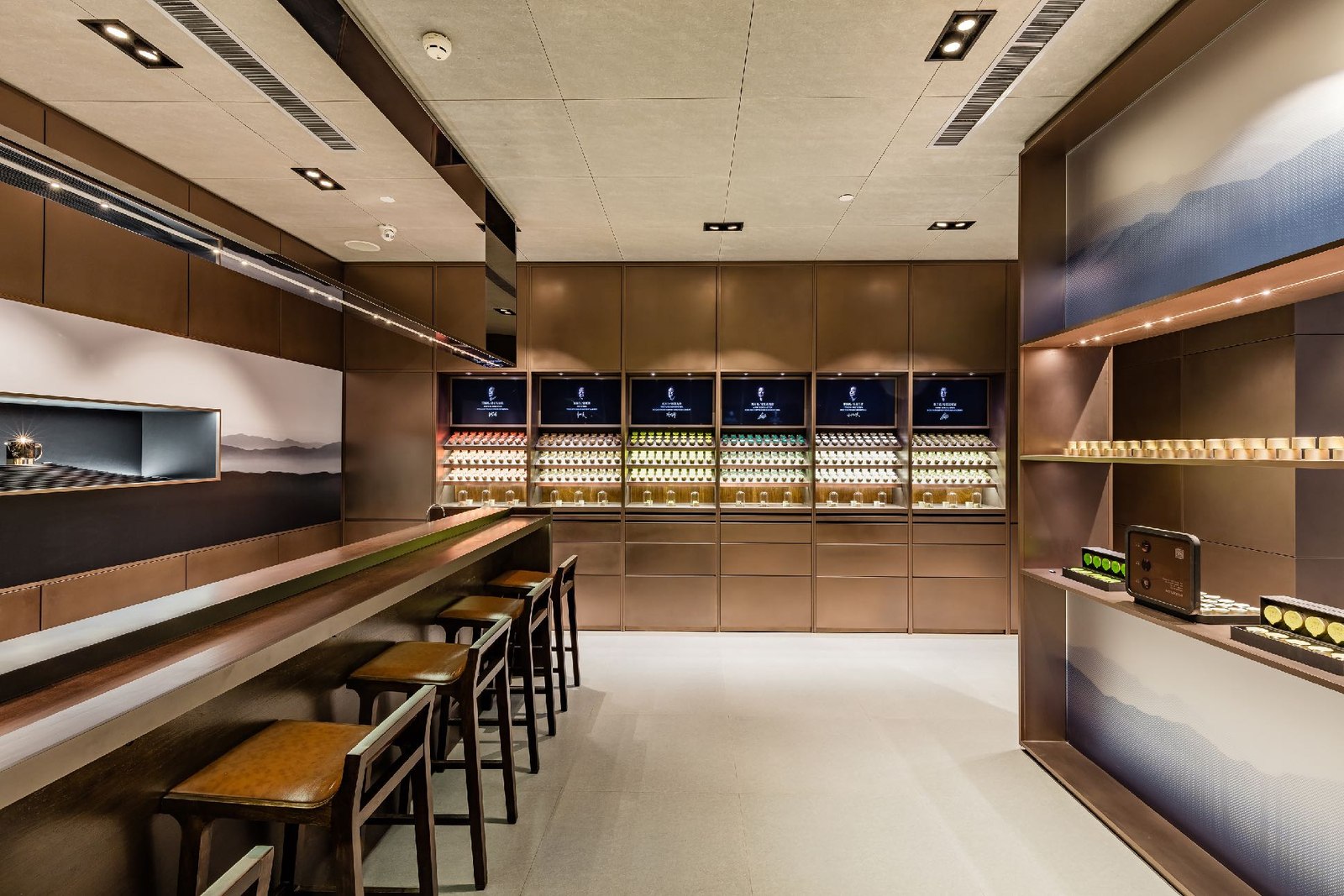
The store drew inspiration from cigar culture and wine cellars—a contemporary tea treasury. A large transparent revolving entrance created architectural presence, while premium display cases and LED screens challenged conventional expectations of a tea shop. The tea bar combined the relaxed atmosphere of a Western bar with the care and precision of Japanese counter service. High stools and timber counters brought contemporary ease together with ritual. Through spatial layers and sight, sound, touch, smell, and taste, buying tea became an enjoyable process of discovery.
06 / CASE STUDY
A commercial offer with a cultural ambition
Xiao Guan Tea’s ambition was to build a globally recognised modern Chinese tea brand. The source article describes a three-year search through tea-growing regions, bringing together resources and selecting eight representative teas. It describes cultivation and processing overseen by eight respected tea masters, as part of the brand’s commitment to quality at that stage of its development. The wider ambition was to carry Chinese tea culture forward and make it accessible to the world.
07 / CASE STUDY
Continuing to explore
As large consumer brands lost some of their dominance and new brands emerged, retail was moving towards more distinct audiences. A focused audience could be a starting point that later developed into broader relevance. The article compares this cultural ambition with the way Starbucks introduced a new social ritual in the United States in the 1990s: Xiao Guan Tea sought to add a contemporary vocabulary to Chinese tea. The exploration remained ongoing, guided by the ambition to build a modern Chinese tea brand with international recognition.
Historical market context
China’s tea market in 2016
Combined share of the top 100 brands
Source: the January 2018 case article. Figures describe the market at the time, not current estimates or project results.
PROJECT SCOPE
- User research and positioning
- Store positioning and experience strategy
- Store experience design
- Integrated brand communication design
Adapted from the supplied case article, retaining its reasoning and examples. Project scope is drawn from T8 Intro. The case includes team experience predating T8 and later brand developments; later programmes are not additional project delivery credits. Market and brand figures follow the source article and do not establish project causation.
Source publication · 30 January 2018